
Chemical Peels in Aventura & Miami | Complete Dermatology
Chemical peels are one of dermatology’s most versatile and proven tools — capable of addressing everything from mild dullness and active acne to deep scarring and decades of sun damage. At Complete Dermatology, serving patients in Aventura, Miami, and throughout South Florida, we offer the full spectrum of physician-grade chemical peels: from gentle lunchtime treatments to advanced procedures available only under physician supervision, including phenol peels, phenol blepharopeel, and CROSS with phenol for acne scars.
South Florida’s year-round sun exposure, humidity, and diverse skin tones make chemical peel selection especially important. Every peel at Complete Dermatology is chosen based on your Fitzpatrick phototype, skin history, and specific goals — not a one-size-fits-all menu. A consultation is required prior to medium and deep peel procedures. Explore our menu options below to learn more about the options for your skin whether its for acne, acne scars, pigmentation, scarring, photoaging, or wrinkles.
Superficial Peels
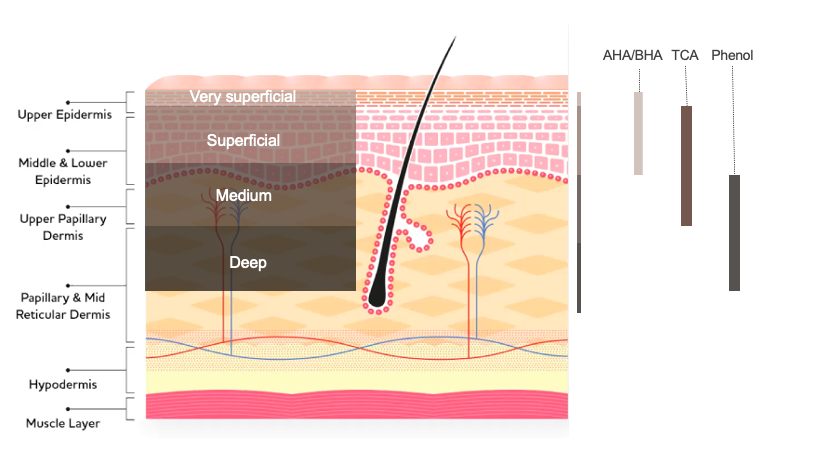
Superficial peels target the outermost layer of the skin (epidermis), requiring little to no downtime. They are ideal for routine maintenance, mild pigmentation, acne control, and overall skin brightening — and can be performed year-round even in sunny South Florida with proper sun protection.
-
Best for: Oily, acne-prone, and combination skin types (Fitzpatrick I–VI)
Conditions treated:
Active acne and clogged pores
Post-inflammatory hyperpigmentation (PIH)
Oily skin and enlarged pores
Superficial texture irregularities
Melasma
Benefits: Salicylic acid is oil-soluble and penetrates deeply into pores, making it uniquely effective for acne-prone skin. It reduces active breakouts, decongests pores, and calms inflammation — a particularly common concern in South Florida’s heat and humidity.
Downtime: Minimal. Mild peeling or flaking possible for 2–4 days.
Frequency: Every 3–4 weeks; a course of 3–6 treatments is recommended.
-
Best for: All skin types, particularly darker skin tones (Fitzpatrick III–VI) and sensitive skin
Conditions treated:
Hyperpigmentation and melasma
Mild acne and rosacea
Fine lines and uneven texture
Post-inflammatory marks
Benefits: Mandelic acid has the largest molecular size of any AHA, meaning it penetrates more slowly and evenly — making it exceptionally well-tolerated by sensitive and darker skin types with a lower risk of post-inflammatory hyperpigmentation than other acids. This makes it a most-requested peel for Miami’s diverse patient population.
Downtime: Minimal. Subtle peeling for 2–3 days.
Frequency: Every 3–4 weeks; 4–6 sessions recommended.
-
Best for: All skin types; mild photodamage and pigmentation (Fitzpatrick I–IV)
Conditions treated:
Fine lines and mild wrinkles
Superficial pigmentation and sunspots
Mild acne scarring
Skin texture and tone refinement
Benefits: Trichloroacetic acid (TCA) at 10% penetrates into the superficial dermis, stimulating collagen production and encouraging controlled skin renewal. More resurfacing power than AHA/BHA peels, with a still-manageable recovery — and excellent results for the early photodamage seen in South Florida patients with years of sun exposure.
Downtime: 3–5 days of peeling and redness.
Frequency: Every 4–6 weeks; 3–4 sessions for optimal results.
Medium-Depth Peels
Medium peels penetrate through the full epidermis and into the papillary dermis, producing more significant resurfacing and visible improvement in wrinkles, pigmentation, and texture. These require physician assessment and pre-treatment skin preparation.
-
Best for: Lighter to medium skin tones (Fitzpatrick I–III); patients with moderate photodamage or acne scarring
Conditions treated:
Moderate wrinkles and photoaging
Actinic keratoses (pre-cancerous lesions)
Moderate acne scarring
Diffuse hyperpigmentation and melasma
Uneven skin tone and texture
Benefits: TCA at 20–30% provides controlled dermal injury that stimulates significant collagen remodeling. Results are considerably more dramatic than superficial peels — with improved skin firmness, reduced lines, and a more even complexion that can last 1–2 years.
For Miami patients with significant UV-related skin damage, this peel is often the most impactful non-surgical option available.
Downtime: 7–10 days. Expect swelling, redness, and peeling. Pre-treatment with retinoids and/or hydroquinone may be recommended.
Frequency: Once every 6–12 months, or as directed by your physician.
Deep Peels
Deep peels penetrate into the mid-reticular dermis, producing the most dramatic and long-lasting results available in chemical peel medicine. These procedures are performed exclusively by our physician and require formal pre-treatment preparation, on-site monitoring, and structured post-procedure care.
-
Best for: Lighter skin tones (Fitzpatrick I–III); patients with significant photoaging or deep wrinkles
Conditions treated:
Deep perioral and periorbital wrinkles
Severe photoaging and solar elastosis
Deep facial rhytids (static wrinkles)
Significant pigmentation irregularities
Benefits: The phenol segmental peel is performed on specific facial regions — most commonly around the mouth or eyes — rather than the full face. This allows for precise, targeted correction of the deepest wrinkles with dramatically less systemic exposure than a full-face phenol peel. Results can last a decade or more. Phenol peels of this depth are performed by very few physicians in South Florida; Complete Dermatology is one of a small number of practices in the Miami and Aventura area offering this procedure.
Downtime: 10–14 days of recovery. Full healing and final results emerge over 2–3 months.
Strict sun avoidance is mandatory — particularly important in South Florida.
Frequency: Once; results are long-lasting. Touch-up may be considered years later.
-
Best for: Lighter skin tones (Fitzpatrick I–III); patients with lower eyelid laxity, crepey skin, or fine lines unresponsive to topical therapy
Conditions treated:
Lower eyelid crepiness and fine lines
Periorbital wrinkles
Mild lower lid skin laxity
Eyelid pigmentation
Benefits: The phenol blepharopeel is a highly specialized technique applied exclusively to the lower eyelid and periorbital region — an area where laser and superficial peels frequently fall short. It delivers deep resurfacing to the delicate eyelid skin, with results comparable to surgical lower blepharoplasty in select patients. This procedure is rare: only a handful of physicians in Florida are trained and experienced in phenol blepharopeel. Patients travel from across South Florida and beyond to Complete Dermatology specifically for this procedure.
Downtime: 10–14 days. Specialized aftercare required. Swelling and temporary eye sensitivity expected.
Frequency: Once; durable long-term results.
-
May be combined with Subcision and Microneedling
Best for: Fitzpatrick skin types I–V; patients with atrophic acne scars including ice pick, boxcar, and rolling scars
Conditions treated:
Ice pick acne scars
Boxcar acne scars
Rolling acne scars
Mixed atrophic scarring
Benefits: CROSS (Chemical Reconstruction of Skin Scars) is a focal technique in which a high-concentration chemical — in our practice, phenol — is applied precisely into the base of individual depressed acne scars. This triggers a controlled inflammatory response and collagen remodeling from the floor of the scar upward, gradually raising and filling the scar over multiple sessions.
At Complete Dermatology, CROSS with phenol is part of a comprehensive acne scar protocol combining three targeted procedures:
CROSS with Phenol — focal collagen induction within each individual scar
Subcision — a minimally invasive technique that severs the fibrous bands tethering rolling scars to deeper tissue, releasing the skin surface
Microneedling — to resurface overall texture, stimulate collagen across the treatment zone, and enhance penetration
Research published in the Journal of Drugs in Dermatology confirms that combining microneedling with phenol CROSS produces significant improvement in atrophic scars —particularly in Fitzpatrick skin types III–V — with minimal side effects and rapid recovery.
This makes the protocol especially well-suited to South Florida’s largely diverse patient population.
Downtime: 5–7 days post-session. Redness and mild swelling at treated sites.
Frequency: Monthly sessions; a course of 3–5 treatments is standard for optimal results.
CUSTOM Peels
-
Availability: Available exclusively through physician prescription and supervision. Not offered at medical spas or aesthetician clinics.
Best for: All skin types seeking progressive resurfacing; patients who have plateaued on topical retinoids; Fitzpatrick I–V
Conditions treated:
Fine lines and early photoaging
Acne and post-acne marks
Melasma and pigmentation
Skin texture, tone, and luminosity
Maintenance between deeper peels
Benefits: The tretinoin peel uses a physician-mixed retinoid formulation applied in-clinic at concentrations not available in any commercial product. Tretinoin accelerates keratinocyte turnover, stimulates dermal collagen synthesis, and corrects abnormal pigmentation at the cellular level. As a compounded formula, concentration and vehicle are customized to each patient’s skin — a level of personalization impossible with off-the-shelf peels. For Miami patients managing chronic sun damage and melasma, this peel is a powerful complement to a long-term skin maintenance program.
Downtime: Mild-to-moderate flaking for 4–7 days.
Frequency: Every 4–6 weeks; 4–6 sessions recommended as a course.
-
Best for: All skin types and Fitzpatrick phototypes, including sensitive skin
Conditions treated:
Mild acne and comedones
Keratosis pilaris
Superficial pigmented lesions and dullness
Fine lines and loss of radiance
Oily and congested skin
Benefits: The Dermaceutic Milk Peel is a Class IIa medical-device certified peel combining glycolic acid, lactic acid, and salicylic acid at a precise pH of 1.9. Clinical data shows 92% of patients reported more luminous skin after just 2 sessions, with 83% noting improved evenness and radiance. It is a true “lunchtime peel” — quick, well-tolerated, and effective for all phototypes with no social downtime. Ideal as a regular maintenance treatment or before a Miami event or occasion.
Downtime: None to minimal. Subtle peeling possible for 1–2 days.
Frequency: Every 2-4 weeks; a course of 3 sessions is standard protocol.
-
Best for: All skin types and phototypes, including darker skin tones prone to PIH
Conditions treated:
Melasma
Solar lentigines (sunspots) and senile lentigines
Post-inflammatory hyperpigmentation
Mild acne and congestion
Hyperkeratosis
Benefits: The Dermaceutic Crystal Peel is a Class IIa medical-device certified peel specifically formulated for pigmentation concerns — one of the most common issues we see in South Florida patients. It targets melanin production and surface pigmentation while promoting even skin renewal, with a protocol designed to minimize irritation across all skin tones. Clinical data supports significant improvement in skin radiance, evenness, and tone after a course of 3 sessions.
Downtime: Minimal. Mild tingling during procedure; subtle flaking may occur.
Frequency: Every 2-4 weeks; 3 sessions at 3-week intervals is the recommended protocol.
Physician-grade chemical peels in Aventura & Miami. Including Phenol peels, Phenol blepharopeel, CROSS with phenol and subcision for acne scars, TCA, compounded tretinoin peels, and custom personalized peels.
Book a Consultation in Aventura
Not sure which peel is right for you? Our physician will assess your skin type, Fitzpatrick phototype, medical history, and goals to design a personalized chemical peel plan. Whether you are looking for a lunchtime refresh or considering an advanced phenol procedure, patients from Miami, Aventura, and throughout South Florida trust Complete Dermatology for expert peel medicine.
Founder, Medical director, & Board-Certified Dermatologist (MD):
Dan Ilkovitch MD, PhD, FAAD
Dr. Dan Ilkovitch is a board-certified dermatologist and MD with extensive expertise in medical, surgical, and cosmetic dermatology. He earned a Bachelor of Science in Biochemistry and Molecular Biology from the University of Maryland before completing both his MD and PhD, in Cancer Immunology, at the University of Miami Miller School of Medicine. Dr. Ilkovitch continued his training with an Internal Medicine internship at Mount Sinai Medical Center and a rigorous dermatology residency at the University of Pittsburgh Medical Center (UPMC). With advanced training in skin cancer surgery, complex medical dermatology, and aesthetic treatments, Dr. Ilkovitch is committed to delivering comprehensive, patient-centered care using the latest techniques in dermatologic medicine and cosmetic procedures.